So I feel I've already contributed all that I am willing and able to snow research. It's getting boring, weather-dependent work is too logistically difficult for me to continue as a long-term career, and dangit, I'm just tired of being out in the cold all the time! I need work that is less harsh and doesn't require so many layers of clothes!
So I've signed on to a new project entirely, under the auspices of the Institute of Arctic Biology. It's a partnership between the Large Animal Research Station and the Kostroma Moose Farm. Guess what I'll be doing? I'll be helping in a project with the long-term goal of domesticating meese!
Why, you ask? No, not for riding, nor for beasts of burden, although this has been tried. Horses and dogs work just fine for that; we aren't trying to reinvent the wheel. The purpose of domesticating moose is for their milk. Apparently, it has medicinal value.
Moose milk is regarded to be a natural product of increased biological value, apparently having diverse therapeutic mechanisms. Moose milk is also used in radiation lesions treatment and for prophylactics of cytostatic disbacteriosis during lymphogranulematosis therapy. First of all, high therapeutical activity is due to high lysozyme activity of 40 - 65 mkg/ml. Fat contents is over 10%; proteins over8%. The content of such essential amino acids as threonine, methionine, histidine and non-essential as serine, glycine, alanine and asparaginic acid in moose milk is twofold higher than that in cow milk. The high value of lipid and fat-acid composition of moose milk is noted, especially in terms of the composition of essential fatty acids. The content of such microelements as silicon, magnesium, aluminium, molybdenum and cobalt exceed their content in cow milk. Moose milk is stored for a long time at a temperature of liquid nitrogen.
Now the moose milk becomes available as economically profitable product. Using it as a source of lysozyme in clinical nutrition enlarges the arsenal of lysozyme-restoring remedies which not only adjust affected body resistance, but also enhance specific immunity, phagocytosis and reparative processes, have antiinflammatory and desensitilizating effect, remove noxious metabolites from the body, improve the composition of intestinal microflora, and enhance blood-histological barriers.
Authors: Antropov E.A., Bespalov G.I., Bogdarin J.A., Brodov A.A., Davydov V.A., Dorofeichuk V.G., Dudin V.A., Dzhurovich V.M., Griaznov D.D., Kozlov G.S., Mikhailov A.P., Vitakova A.N., Zaikina M.G. (Yaroslavl Medical Institute, Yaroslavl, Research Institute of Pediatrics, Gorki, Forest Experimental Station, Kostroma), presented at the Third International Moose Symposium.
I've got to attend an International Moose Symposium!
You must look at this footage of a pet moose:
I might just get me a pet moose!
Edit: Happy April Fool's Day!
But the Kostroma Moose Farm is real, and so is that video. I have no idea what the situation is, but I agree with my mudder that it is Not a Good Idea. In the video, I mean. The Kostroma Moose Farm is awesome, and I encourage you to go check out their site and look at their photos of semi-tame meese, especially the fuzzy behbehs. So adorable! And that article is real, too. Those folks are actually milking meese for medicinal purposes. Yay meese!
Friday, April 1, 2011

Wednesday, March 30, 2011
Spring progresses
So this morning I took the flexible hose that serves as a water line from my reservoir to my sink, lifted it off the kitchen counter, and slid it behind so it will be out of the way on the floor. No concerns about it freezing any more! I also took the power cord that feeds the heat tape that lines my outflow pipe (to prevent the outflow from freezing too close to the house), and rolled it into a circle and tucked it away behind the stove. No need for that again, either! My second winter in this cabin, I figured out how much water I need to pour down the drain at once to keep it flowing nicely, and I haven't had to go out and break up the slop glacier this year at all.
It's warm enough to make the snow packable, so of course I had to build another snowman to replace the one from the ice storm, who had since lost his head and accumulated shoulder pads.

This one doesn't get a hat, as I can't afford to keep providing nesting material to local ravens.

My flamingos are also starting to appear:

It's warm enough to make the snow packable, so of course I had to build another snowman to replace the one from the ice storm, who had since lost his head and accumulated shoulder pads.

This one doesn't get a hat, as I can't afford to keep providing nesting material to local ravens.

My flamingos are also starting to appear:

Monday, March 28, 2011
Winter fights back
With a several-inches snow dump last night and more on the way.
My icicles, however, are continuing to grow in savagery:

My icicles, however, are continuing to grow in savagery:

Sunday, March 27, 2011
Photos 'round the hood
I use this lightning-struck tree at the top of our neighborhood ridge line as a direction-finder and beacon.

It's picturesque, isn't it?

A friend told me that birch bracts look like birds when you look closely, so I examined a few and agreed with the assessment. :)
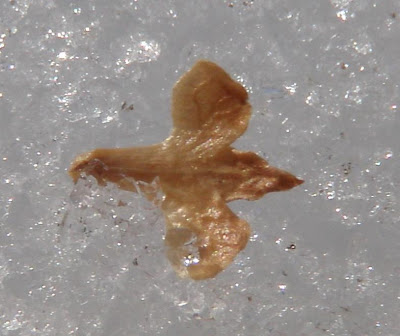
The seeds shed from the trees in deep winter, sit atop the snow and wreak a bit of havoc for skiers who are suddenly slowed down by the friction they produce, and then gradually are covered by subsequent snow, to awaken in the spring conveniently surrounded by water for germination.

Rosie Creek, across which I ski to access the trails, is already covered with overflow ice. When the creek fully thaws, my trail access ends. :(


Ssssspookeh trees at the bottom of my hill. I sometimes consider cutting them down to have a beautiful view to the south, like my neighbor does, but I like my privacy.


Icicles!


It's picturesque, isn't it?

A friend told me that birch bracts look like birds when you look closely, so I examined a few and agreed with the assessment. :)

The seeds shed from the trees in deep winter, sit atop the snow and wreak a bit of havoc for skiers who are suddenly slowed down by the friction they produce, and then gradually are covered by subsequent snow, to awaken in the spring conveniently surrounded by water for germination.

Rosie Creek, across which I ski to access the trails, is already covered with overflow ice. When the creek fully thaws, my trail access ends. :(


Ssssspookeh trees at the bottom of my hill. I sometimes consider cutting them down to have a beautiful view to the south, like my neighbor does, but I like my privacy.


Icicles!

Saturday, March 26, 2011
Scenes of Breakup
Slush on the streets:


Icicles dripping from my roof:

This is the second year in a row that breakup's seeming to come early. But meteorologist Corey Bogel sez in The Minor News that "'It can still get cold; that’s why you don’t want to count April out yet,'... noting the record low on Friday was 39 below in 1935. Most of the record lows in the first of April are in the 20s and 30s below."
Oh, here is a raven eating snow:


He's NOT a harbinger of spring, as he hangs around all winter.
A woodchuck awaking, however, is a sign of spring!


Icicles dripping from my roof:

This is the second year in a row that breakup's seeming to come early. But meteorologist Corey Bogel sez in The Minor News that "'It can still get cold; that’s why you don’t want to count April out yet,'... noting the record low on Friday was 39 below in 1935. Most of the record lows in the first of April are in the 20s and 30s below."
Oh, here is a raven eating snow:


He's NOT a harbinger of spring, as he hangs around all winter.
A woodchuck awaking, however, is a sign of spring!
Friday, March 25, 2011
I-have-too-many-overripe-tomatoes pasta
Mmmm tomatoey pasta:

Nice photo, but whom am I kidding? This is how I eat pasta:

Portraits of my familial creatures and self:


Nice photo, but whom am I kidding? This is how I eat pasta:

Portraits of my familial creatures and self:

So that's it
There's no denying it. Spring has sprung. Winter is over. This is breakup. I should snap some photos for you, my all six loyal readers. The disintegrating snow piles, accompanying mud, and splattered dirty icicles aren't particularly photogenic, but I aim to report, not always be pleasant.
This weekend will be my last opportunity to collect snow and stow it away in tupperwares in my lab freezer to continue work through the summer.
But the sun sure is lovely. I was waiting out in the parking lot to meet some friends the other morning. It was maybe around 10 a.m., and not only was the sun up, but it was warm and golden, and I could feel it on my skin. It's a pleasant thing indeed.
My good friend and weekly ski buddy M informed me last night of her opinion that this weekend is the last we shall ski together for the season. So sad.
In other news, I've just roughly summed that there are about the same number, or probably slightly more, of caribou in Alaska than humans. Prompted by the report of the census of the Western Arctic herd.
Here are the numbers I found on the internet:
123,000 Porcupine
32,000 Central Arctic
50,000 Fortymile
45,000 Nelchina
150,000 Mulchatna
348,000 Western Arctic
That's a lot of 'bous.
Here is a photo of the famous Porcupine Herd, compliments of Thundafunda.

This weekend will be my last opportunity to collect snow and stow it away in tupperwares in my lab freezer to continue work through the summer.
But the sun sure is lovely. I was waiting out in the parking lot to meet some friends the other morning. It was maybe around 10 a.m., and not only was the sun up, but it was warm and golden, and I could feel it on my skin. It's a pleasant thing indeed.
My good friend and weekly ski buddy M informed me last night of her opinion that this weekend is the last we shall ski together for the season. So sad.
In other news, I've just roughly summed that there are about the same number, or probably slightly more, of caribou in Alaska than humans. Prompted by the report of the census of the Western Arctic herd.
Here are the numbers I found on the internet:
123,000 Porcupine
32,000 Central Arctic
50,000 Fortymile
45,000 Nelchina
150,000 Mulchatna
348,000 Western Arctic
That's a lot of 'bous.
Here is a photo of the famous Porcupine Herd, compliments of Thundafunda.

Subscribe to:
Posts (Atom)